Strain & Depletion
Expression: Stress & depletion
Pattern: Liver qi Stagnation
*Traditional Chinese Medicine treats the individual, not just the symptom. The information and recipes provided here are intended as an introduction to a long-standing healing tradition, not as personal medical advice*
I used to think my mother only owned one set of clothing. The baggy white cotton shorts, the shirt that collapsed in on itself and a pair of scuffed loafers for polish. She was consistency, sheer, utter, exhausted consistency.
“I did my job,” a perfunctory refrain from an impossibly beautiful woman who saw hard work as a reflection of her character and constitution. We, her children, were her work. When an inheritance of Confucian duty and discipline collides with gendered expectations and the survival logic shaped by war, famine, immigration, and discrimination, rest becomes entangled with shame.
Across generations, the dynamic between labor and worth calcifies and we absorb not only the values, behavioral patterns, fears and unspoken rules of our forebearers, but also the nervous system dysregulation that underpins the fragile balance of health.
LIVER QI STAGNATION
WHAT IS LIVER QI?
In Traditional Chinese Medicine (TCM), the Liver system is closely tied to emotional regulation, stress response and the smooth processing and expression of emotion. The Liver is considered both a functional system and symbolic network, not just the physical liver organ. Liver qi is the functional energy associated with with this system and is connected to the ability to move through stress and keep circulation, energy, digestion, menstrual flow and physical tension in check.
HOW IS A PATTERN OF LIVER QI STAGNATION EXPRESSED?
When liver qi becomes impaired, the pattern is referred to as Liver qi stagnation, a state linked to emotional constriction, accumulated stress, and physiological tension. Symptoms or expression may include:
tight shoulders or jaw
chest tension
rib-side tightness
bloating
headaches
PMS, breast tenderness, cycle irregularity
frequent sighing
irritability and frustration
tension
emotionally stuck
emotional suppression
digestive symptoms worsened by stress
WHEN DOES THIS APPEAR IN A WOMAN’S LIFECYCLE?
Liver qi stagnation emerges during periods when a woman must continuously hold, manage, suppress, adapt, or carry more than the body can smoothly move. It is associated with. It can appear at any stage of life, but it is especially common during periods of transition, emotional pressure, constrained identity, or chronic stress.
In adolescence, as menstruation begins and emotions intensify, stagnation may appear as PMS, mood swings, irritability, painful periods, emotional volatility and headaches. The Liver system is connected to menstruation and emotional flow, so hormonal shifts can amplify underlying stagnation.
In mid-life, especially during the reproductive years, women are expected to be the carers, constantly prioritizing and adapting to others’ needs while remaining emotionally regulated and restrained. This prolonged emotional containment and tension can constrain Liver qi and may be experienced as resentment, burnout, PMS and digestive issues
In perimenopause, not only are women experiencing hormonal shifts but a major energetic transition requiring adaptation and conservation of resources. This is a period where Liver qi stagnation often surfaces or combines with deeper depletion patterns.
SUPPORTING LIVER QI BALANCE
Liver qi stagnation is supported by emotional release and restores movement and circulation. The goal is not simply to “calm down,” but instead to help restore physical, emotional and energetic flow.
FOOD THERAPY
In TCM, foods that support Liver qi are generally fresh, aromatic, and rich in plant compounds. Rather than nourishing the Liver directly, foods are thought to encourage smooth movement or quality of breath, digestion, circulation, emotions throughout the body, helping to counteract the sense of physical and emotional constraint associated with stagnation. Lightly warming foods help Liver qi not because warmth is the goal itself, but because warmth encourages movement in circulation, digestion, and emotions.
Lightly warming food
Pepper
Scallions and Leeks
Fennel
Oats
Carrots and Sweet Potatoes
Chicken
Bitter greens, dandelion, mustard greens, celery
Nourishing Liver qi w/food
Katie Kwan, Rice, Paper, Scissors
1 chicken leg (thigh and drumstick)
3 inch piece of ginger, peeled and smashed
2 inch piece of fresh turmeric, peeled and smashed
1 large bunch or 8 cups bitter greens mustard greens, washed dried and roughly chopped into 1.5” pieces
2 T avocado oil
8 cups filtered water
Salt or fish sauce to taste
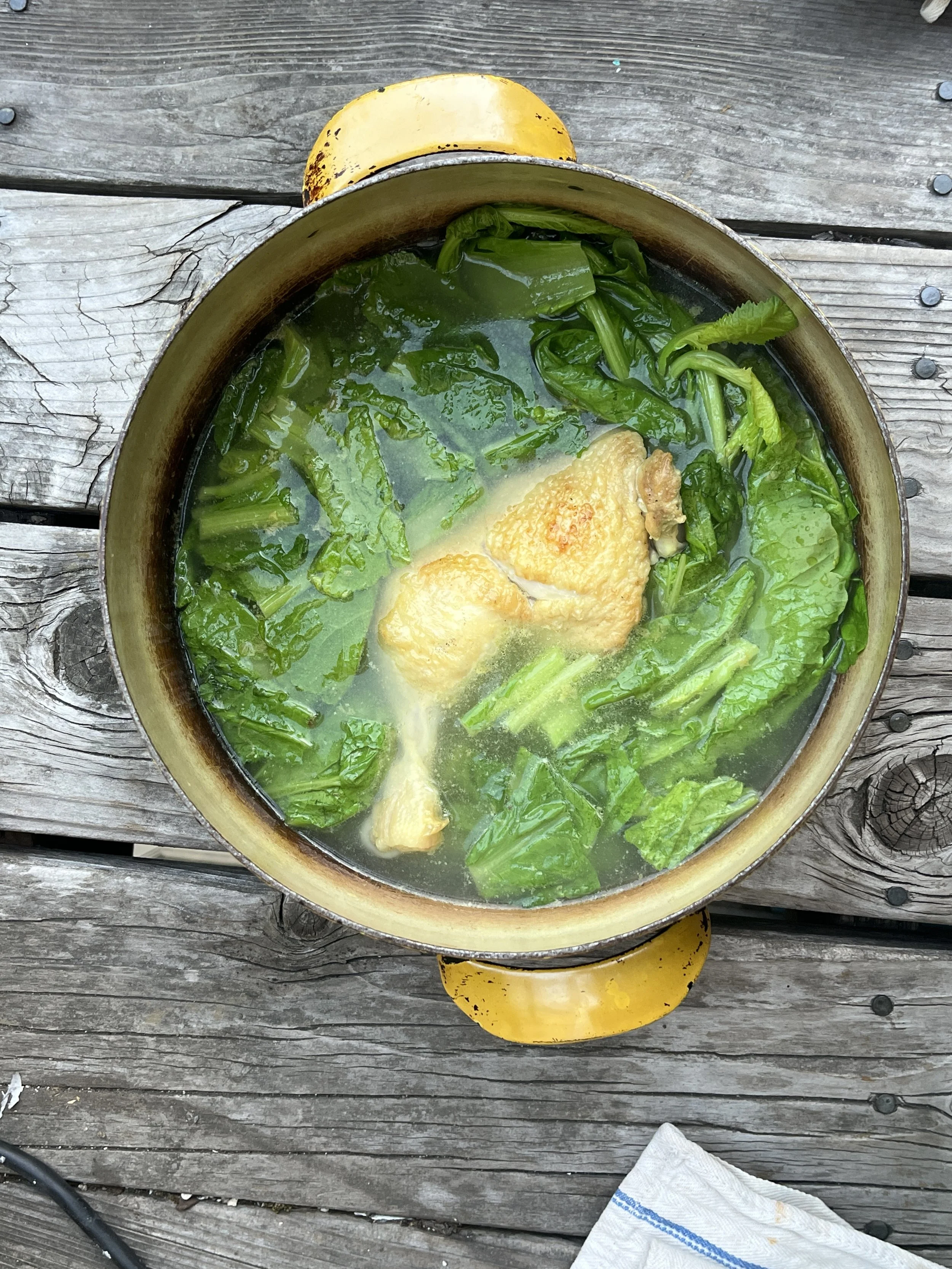
BITTER GREENS SOUP
Warming, strengthening, tonifying
MOVEMENT THERAPY
Flowing movement helps support Liver qi by encouraging the smooth circulation of energy, easing physical tension, and creating space for emotions to be processed and expressed rather than held or constrained.
Movement that supports Liver Qi Stagnation
stretching
twisting movements
breath work
creative flow
crying
resting
Walking, particularly outdoors in nature
Dancing, especially free-form or expressive dance
Gentle yoga with twists, side bends, and hip-opening poses
Nourishing Liver qi w/movement
Shaking the Body (“Shaking Qi”)
A common practice in Qigong. The goal is not performance. It is discharge and circulation. Many people notice warmth, tingling, emotional release, or deeper breathing afterward.
Stand with feet hip-width apart
Slightly bend knees
Begin gently bouncing through the heels
Let the arms hang loose and shake naturally
Relax the jaw and belly
Breathe normally for 1–3 minutes
HERBAL THERAPY
The herbs most commonly used to support Liver qi are typically aromatic and encourage gentle dispersion and movement. Rather than strongly tonifying or sedating, they help encourage the smooth flow of qi, especially when there is tension, frustration, stress, or a sense of being "stuck.”
Aromatics
Dried rose buds/mei hua gua/may gway hwah/玫瑰花
Aged & dried citrus peel/chen pi/Chén Pí/chun pee/陈皮
Bupleurum root/chai hu/chai hoo/柴胡
Cyperus rhizome/xiang fu/shee-ahng foo/香附
Nourishing Liver qi w/herbalism
This gently warming decoction combines aromatic herbs traditionally used to support the smooth flow of Liver qi, ease tension, and promote digestive comfort during periods of stress or emotional constraint.
Liver Qi Decoction
3–4 slices fresh ginger
1 tsp dried tangerine peel (or fresh orange peel)
1 tsp dried rose buds or rose petals
Small handful mint leaves
2–3 red dates (jujubes), sliced
Small slice licorice root or a drizzle of honey
Optional: chrysanthemum flowers for heat/irritability
Preparation:
Add ingredients to 4 cups of water
Bring to a gentle boil
Reduce heat and simmer uncovered for 20–30 minutes
Strain and drink warm
